
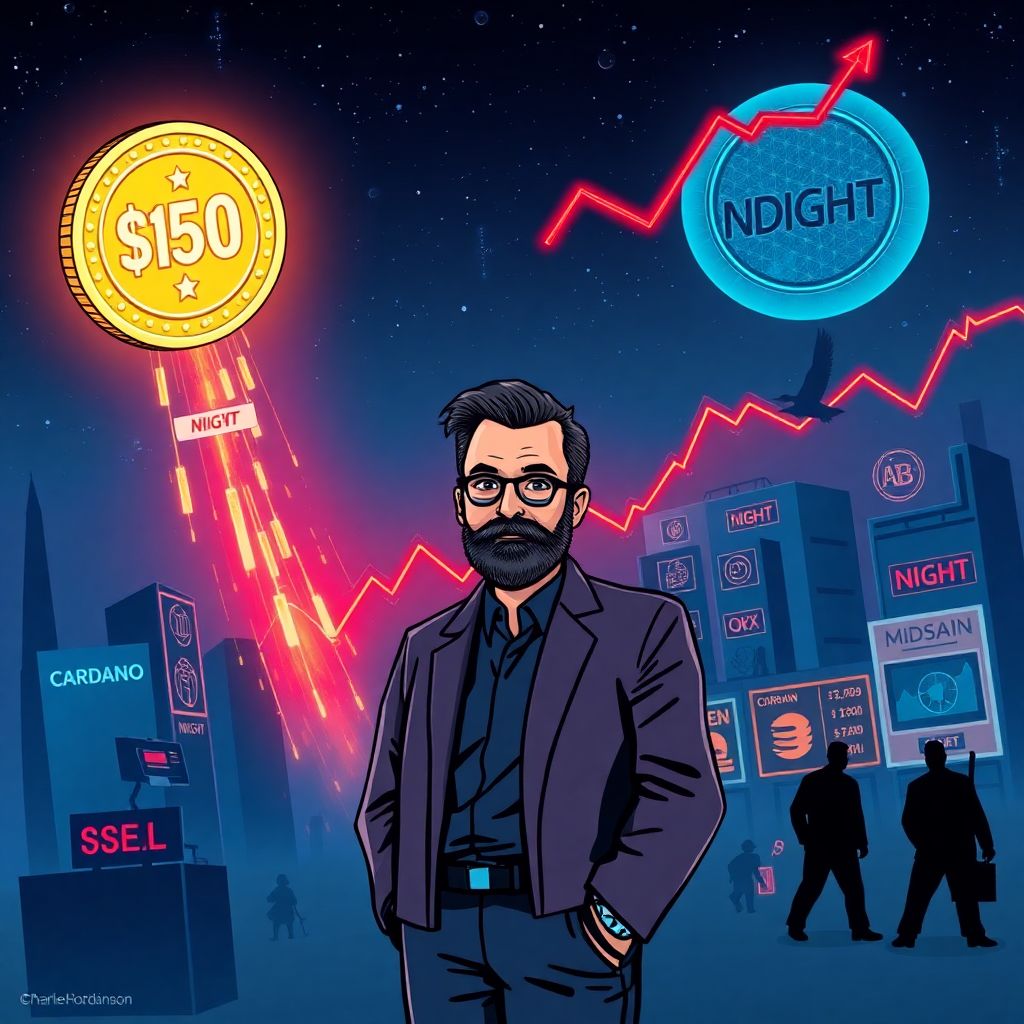
Cardano Founder Defends Midnight Launch As NIGHT Token Plummets From $150 To $0.02
Cardano’s long-awaited privacy-focused sidechain Midnight went live with what its creator Charles Hoskinson describes as the most powerful token launch in the project’s history – even as its native asset NIGHT suffered a dramatic price collapse from an initial spike near 150 dollars to just 2 cents.
In a December 10 livestream titled “Midnight Launch AAR,” Hoskinson directly addressed the extreme volatility that dominated traders’ attention. He acknowledged that the opening price was completely out of touch with fundamentals: according to him, NIGHT “launched at almost 150 dollars,” a level he called “insane” and unsustainable from the outset.
The euphoric spike was short-lived. As soon as trading opened on centralized platforms like Binance Alpha, the price reversed sharply. Hoskinson described the move as a classic speculative dump: once the token became accessible to highly aggressive traders, “all the way down to two cents. They dumped on us. That’s what they do. That’s what the DGENs over in that market do.”
Despite the emotional reaction online, he insisted this was not evidence of a structural flaw in Midnight or Cardano. Instead, he framed the crash as a textbook case of exchange-driven distribution. Many recipients, he argued, had no genuine interest in the underlying technology or long-term ecosystem: they “regardless of the price, just dump the token,” and “probably didn’t even know what NIGHT was.” In other words, the initial move was driven more by short-term opportunism than by any reasoned valuation.
Hoskinson emphasized that violent price swings are normal in the first days of a new asset, particularly in a stagnant or uncertain crypto market. In his view, launches typically go through 48 to 72 hours of “high volatility,” with large candles and cascading liquidations, before finding a more stable trading band. For NIGHT, he said he had expected a reasonable early range to settle somewhere between 5 and 15 cents.
By the time of his remarks, NIGHT was hovering around 6 to 6.5 cents, implying a fully diluted valuation (FDV) of approximately 1.5 billion dollars and roughly 150 million dollars in trading volume. For a just-launched Cardano-native token under current market conditions, Hoskinson called those numbers “a really solid launch,” despite the painful optics of the initial crash from triple-digit prices.
What made the debut historically important for Cardano, according to Hoskinson, was not the intraday price chart but the combination of large exchange listings and on-chain metrics. He stressed that this is the first time the network has been able to send a multi-billion-dollar asset directly into top-tier liquidity venues from day one. NIGHT went live with immediate listings on platforms such as Binance Alpha, Kraken, OKX and other major players, a level of institutional and retail access Cardano projects did not previously enjoy.
He underlined that reaching this point required significant groundwork. A lot of the infrastructure that now makes it possible to list a Cardano-native token at scale “wasn’t there” even a short time ago, he said. The Midnight rollout forced the ecosystem to mature rapidly: tooling, liquidity routing, custody solutions and integration pipelines all had to be built or upgraded in the run-up to launch.
On the Cardano chain itself, NIGHT instantly became the dominant asset by trading activity. Citing data from on-chain analytics platforms, Hoskinson noted that NIGHT commanded an “overwhelming level of volume,” surpassing the combined trading volume of every other Cardano native token. He said the token’s fully diluted valuation was also higher than the aggregated FDV of all other Cardano native tokens (CNTs) at the time.
This surge in activity had important second-order effects. For the first time, decentralized exchanges (DEXs) on Cardano – including platforms such as Minswap and SundaeSwap – carried what Hoskinson called a “meaningful percentage” of total trading volume relative to major centralized exchanges. That shift helped “prime the pump on Cardano DEXes,” attracting additional liquidity and, crucially, more stablecoins into the Cardano ecosystem. In his view, this is exactly the sort of flywheel effect Cardano has needed: high-profile launches driving on-chain usage instead of relying solely on off-chain speculation.
Another central theme of Hoskinson’s comments was the distribution model behind NIGHT. He praised the so-called Glacier Drop mechanism, which gradually “thaws” tokens into circulation. Rather than dumping a massive allocation onto the market at once, this system releases tokens over time, creating what he described as “a nice steady emission and a nice steady flow for the system as opposed to a jagged thing where the insiders all dump.”
He contrasted Midnight’s approach with the typical venture capital-driven launches seen elsewhere in the industry, where early backers receive large allocations at steep discounts and then exit into retail liquidity. According to Hoskinson, Midnight flips this script: “This is the first time since Bitcoin that a launch has been done the way that Midnight did it. It was complete retail, completely fair, and none of those damn VCs got their grubby hands on it. Instead, it went right to you, the people.”
This rhetoric ties into a broader narrative he has been building around “returning to first principles” in crypto. In his view, the next major adoption cycle – which he is targeting around 2026 – will reward projects that combine fair distribution with sound monetary policy: fixed supply, predictable or deflationary tokenomics, and strong alignment with users rather than institutions. NIGHT fits that template, he argued, as it has a capped supply and is designed to incentivize participation in Midnight’s confidentiality-focused ecosystem. “It’s going to be a good year for everybody who’s betting on you, the consumer, and not betting on the banks,” he said.
Looking ahead, Hoskinson positioned Midnight as Cardano’s first true “partner chain” – a semi-autonomous network that connects deeply to Cardano while also reaching into other ecosystems. He described Midnight as the “tip of the spear” for a new generation of hybrid decentralized applications that will operate across multiple chains. In his roadmap, developers might deploy “Midnight Cardano, Midnight Ethereum, Midnight Solana, Midnight Avalanche, Midnight Binance,” using Midnight as a privacy and compliance layer that can interface with different base layers.
He outlined a staged rollout for this vision. After Midnight completes its first four planned phases, he expects a new external ecosystem to be integrated roughly every two months. On top of that, he projected ongoing feature updates every six to eight weeks, suggesting a cadence of continuous development intended to keep Midnight technically competitive and relevant to builders across the industry.
Hoskinson also framed Midnight as a strategic weapon for Cardano-based DApps. By offering confidentiality, data protection and more sophisticated compliance options, Midnight is meant to give Cardano projects an edge when competing with applications built on other smart-contract platforms. With tools that can shield sensitive user data while still enabling auditability and regulatory alignment, Cardano developers could, in theory, target use cases – such as enterprise workflows, regulated financial products or identity-based services – that are hard to implement on fully public ledgers.
For current and prospective token holders, the enormous price range – from 150 dollars to mere cents – raises obvious concerns. Hoskinson’s message was that the spike and crash are largely noise compared to the long-term objective: building a robust ecosystem around Midnight. He implicitly warned that those fixated solely on intraday charts are likely to misunderstand how young networks mature. In early stages, liquidity is thin, price discovery is chaotic and narratives overshoot in both directions. From his perspective, the more important metrics are sustained trading volume, growing on-chain activity and gradual expansion into real-world use cases.
At the same time, the launch has become a case study in the double-edged nature of instant access to top exchanges. On one hand, day-one listings on major platforms dramatically increase visibility and liquidity, attracting users who otherwise might never look at a Cardano-related project. On the other hand, they expose the token to brutal short-term speculation, where bots and high-frequency traders exploit thin order books and emotional retail participants. NIGHT’s rapid collapse after listing illustrates how these forces can overwhelm fundamentals in the short run.
For the Cardano ecosystem, Midnight’s debut serves as a stress test of infrastructure and community readiness. It reveals how quickly wallets, DEXs, analytics tools and custodial solutions can adapt to sudden surges in demand. It also exposes gaps: user experience issues, education deficits and confusion around claiming, staking or using the new token. How well Cardano’s developers and community respond to these pain points in the coming months will influence whether Midnight’s initial momentum transforms into lasting adoption.
From a broader market perspective, NIGHT’s trajectory highlights the tension between “fair launch” ideals and speculative reality. Even without venture capital allocations, the token still experienced extreme volatility and aggressive dumping. Fair distribution can improve perceived legitimacy and align long-term incentives, but it does not magically remove the influence of short-term traders. What it may do, however, is reduce systemic sell pressure from heavily discounted insiders and tilt the playing field slightly more toward genuine users.
Longer term, the success of Midnight will be measured less by its token price and more by whether developers choose to build on it. If it can attract privacy-conscious DApps, institutional pilots or cross-chain tooling that relies on its confidentiality features, NIGHT could evolve into a utility asset with durable demand. If, instead, it remains primarily a speculative vehicle with limited real-world integration, its valuation is likely to mirror broader market cycles and sentiment around Cardano as a whole.
In that context, Hoskinson’s framing of the launch as Cardano’s “strongest ever” is as much about signaling as it is about raw numbers. The message he is sending to the market is that Cardano has finally reached a stage where it can support billion-dollar assets, compete on liquidity, and roll out complex partner chains without collapsing under technical or organizational strain. Whether investors accept that narrative will depend on what comes next: concrete partnerships, working applications and evidence that Midnight can do something meaningfully different from existing privacy or data-protection solutions.
For now, NIGHT stands as a stark reminder of crypto’s volatility and of the gap between engineering milestones and market behavior. A token can be launched fairly, engineered thoughtfully and supported by a detailed roadmap – and still suffer a 99 percent drawdown in hours. Hoskinson’s response is to interpret that chaos as a natural phase in price discovery and a test that the Cardano ecosystem, in his view, has passed. The real verdict, however, will emerge over the coming years as Midnight either grows into the multi-chain privacy backbone he envisions or becomes another short-lived narrative in an industry full of them.