
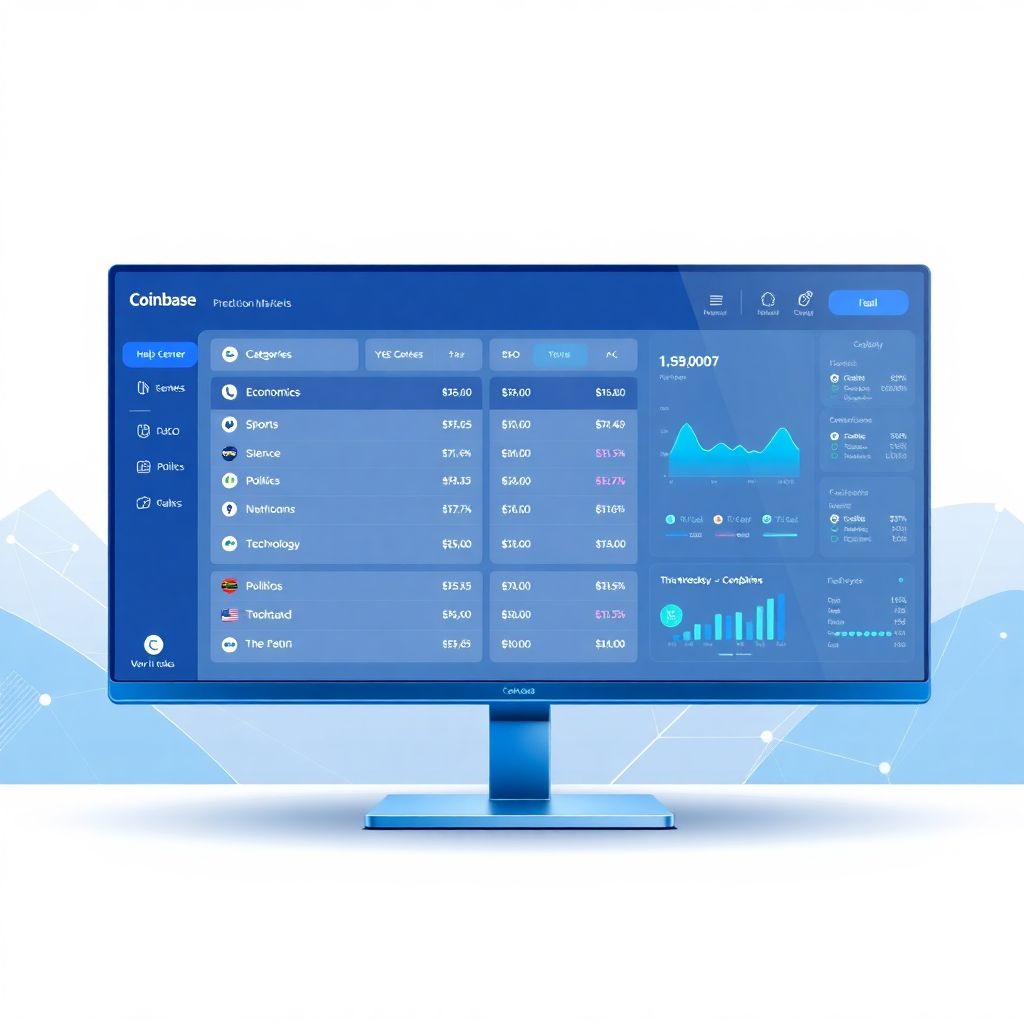
Coinbase is quietly preparing to enter the prediction markets race with a dedicated website powered by Kalshi’s infrastructure, according to findings from independent tech researcher Jane Manchun Wong. Known for uncovering hidden and unreleased features across major tech platforms, Wong shared screenshots that appear to show an in-development prediction market product tightly integrated into the Coinbase ecosystem.
The images suggest that the service will be offered through Coinbase Financial Markets, the derivatives-focused subsidiary of Coinbase Global. In the fine print on one of the screenshots, the interface explicitly states that the contracts are provided via Kalshi, a regulated prediction market venue. That implies Coinbase is not building the entire stack from scratch, but rather plugging into Kalshi’s existing event-contract framework while acting as a front-end brand and access point for its user base.
The leaked interface resembles a standard prediction market dashboard, but with Coinbase’s familiar branding and design language. Visible elements include an event list, pricing odds, and clearly labeled “Yes/No” style contracts, alongside a help center and FAQ section explaining how event contracts work. A separate “How it works” guide in the screenshots walks users through the mechanics of trading outcomes, positioning the product as a regulated, investment-style way to bet on real-world events rather than as pure gambling.
Wong’s screenshots also indicate that Coinbase plans to support both USDC and US dollars as settlement currencies on the platform. That dual support signals an attempt to bridge traditional finance users and crypto-native traders, allowing people who are more comfortable with fiat to participate while still promoting on-chain stablecoins as a core part of the product. The listed event categories in the images span economics, sports, science, politics and technology, with language hinting that new markets will be launched on a rolling basis.
Coinbase has already telegraphed its broader ambition in this direction. In mid-2024, executives said the firm wants to evolve into an “everything exchange,” where users can access not only spot crypto trading, but also derivatives, stablecoins, and eventually markets tied to real-world events. A formal partnership between Coinbase and Kalshi was announced in November, with Coinbase taking on the role of custodian for USDC-based event contracts. The newly surfaced prediction market interface appears to be the next logical step in that collaboration, pushing the product directly into Coinbase’s retail and institutional funnels.
Neither Coinbase nor Kalshi have publicly commented on the leaked screenshots or offered a launch timeline. However, Wong’s track record lends weight to the discovery. She has previously revealed unreleased features at companies such as Facebook, Instagram and X by analyzing publicly available source code and buried interface assets, many of which later rolled out in official product updates. Her latest findings suggest Coinbase is far enough along in development to have a working UI with legal disclosures and user education content already in place.
The move comes at a time when prediction markets are rapidly gaining momentum both inside and outside the crypto industry. Platforms like Kalshi and Polymarket have reported surging volumes in 2024, as traders flock to markets tied to elections, macroeconomic indicators, sports outcomes and cultural events. For many users, these markets serve as an alternative way to express views on real-world developments, hedge against risks, or simply speculate with a clearer link to tangible outcomes than many meme tokens or purely synthetic derivatives.
Unsurprisingly, large crypto exchanges have started to reposition themselves to capitalize on this interest. Some are forging partnerships with existing prediction market operators, while others are building proprietary platforms. Crypto.com, for example, has begun rolling out its own prediction market product, designed to integrate with high-profile media and politics-related brands. Gemini, meanwhile, has framed its upcoming prediction market as a component of a broader “super app” strategy, and has taken regulatory steps toward becoming a formally designated contract market under US derivatives rules.
For Coinbase, the calculus is straightforward: prediction markets sit at the intersection of trading, data, and narrative — three areas where the exchange already has significant infrastructure and a large user base. By front-ending Kalshi’s regulated contracts, Coinbase can potentially offer users a familiar experience while relying on Kalshi’s licensing and compliance framework for event markets. If executed well, that could shorten time-to-market and reduce regulatory friction compared to building a fully independent venue.
At a strategic level, integrating prediction markets could deepen user engagement across the Coinbase product suite. A trader already holding USDC on the platform might be more willing to deploy part of their balance into an election outcome contract or a Federal Reserve rate decision market than to off-ramp into traditional brokerages. For institutional clients, event contracts may offer novel hedging strategies around macro-economic announcements or geopolitical risk, especially if liquidity grows large enough.
The regulatory angle is crucial. Event contracts in the United States often fall under the oversight of derivatives authorities, particularly when they are structured to resemble binary options on quantifiable real-world outcomes. Kalshi has positioned itself as a compliant, regulated venue for such contracts, which is likely one reason Coinbase chose it as a partner. By routing prediction market activity through a platform already in dialogue with US regulators, Coinbase can argue that it is extending access to regulated financial products rather than launching an unregulated betting site.
User experience will also be a key differentiator. The leaked screenshots suggest Coinbase is investing in education and framing these markets in accessible, non-technical language. FAQs appear to cover risks, settlement rules, and the difference between investing in crypto assets versus trading event outcomes. If Coinbase can simplify concepts like implied probability, contract settlement, and market resolution for a broad audience, it could bring prediction markets closer to the mainstream than purely crypto-native platforms with more complex or jargon-heavy interfaces.
From an industry perspective, Coinbase’s entry could accelerate the trend toward “financialization of news.” As more traders gain the ability to immediately price in expectations about elections, inflation reports, sports championships or technology launches, prediction markets may become an additional data point for analysts and journalists monitoring public sentiment. Over time, these markets could function as real-time forecasting tools, sitting alongside polls, analyst surveys and economic models.
At the same time, the expansion of prediction markets raises policy and ethical questions. Critics worry that markets on sensitive political or social events may distort incentives, invite manipulation, or blur the line between informed speculation and exploitative betting. Supporters counter that well-designed markets, especially those under regulatory supervision, can surface collective intelligence and yield more accurate forecasts than traditional polling. Coinbase’s choice of categories — and any future restrictions or guardrails — will likely be closely scrutinized.
If Coinbase’s platform launches successfully, competition in the space will intensify. Smaller prediction market startups may benefit from the increased visibility and user education driven by large exchanges, but they could also face pressure on fees, liquidity, and brand recognition. Larger exchanges that have not yet moved into prediction markets may be forced to accelerate their plans or form new partnerships to avoid ceding ground to early movers.
Another important dimension is the role of stablecoins. By emphasizing USDC as a primary settlement asset for event contracts, Coinbase and Kalshi are reinforcing the narrative of stablecoins as a backbone for programmable, event-driven finance. That could have downstream effects on stablecoin adoption, cross-platform interoperability, and the design of future financial products that combine tokenized assets with real-world data feeds.
Ultimately, Coinbase’s reported work on a Kalshi-powered prediction market underscores a broader shift in crypto: away from purely speculative token trading and toward a wider spectrum of financial instruments linked to real-world information. Whether this new platform becomes a niche side product or a core pillar of Coinbase’s “everything exchange” vision will depend on regulatory approval, user trust, product design — and the market’s appetite for turning opinions about the future into tradable assets.